During the Revolution, Continental soldiers camped near a wooden Presbyterian meeting house on what is now Route 52 and used it as a smallpox hospital. According to the Fishkill Historical Society, they also damaged it badly by "stripping the siding… as high as they could to boil their camp kettles," and to keep warm. The building is long gone. Its outline is still visible in Rombout Rural Cemetery, an open, grassy patch with burial markers on three sides.
Winter at the Fishkill Supply Depot meant soldiers trying to stay warm, and very little of it was marked off as a park afterward. The depot's history sits in a churchyard, a house by an interstate ramp and two churches on Main Street, all places Fishkill residents drive past every week. This fall, work started on the one depot corner most people have heard of, and the other sites are where you can walk this winter.
The Corner on Route 9 Is Now a Work Site
The Highlands Current reported in late October that clearing had begun for Continental Commons. The project is on 10.5 acres of Route 9 between Snook Road and Van Wyck Lake Road. The approved plan has a 2½-story hotel with 90 rooms, 15,720 square feet of retail space in two buildings, 5,000 square feet of restaurant space, a visitors' center and a museum. The plan went to the Fishkill Planning Board in 2015 and was approved in 2023. Supervisor Ozzy Albra told the paper the site was being prepared for the visitors' center and museum.
The land was part of the Fishkill Supply Depot. George Washington set up the 74-acre encampment, which reached from northern Philipstown to the Village of Fishkill and into present-day Beacon. The parcel sits across Route 9 from Dutchess Mall and across Snook Road from the Van Wyck Homestead. It has a memorial marker to the people who served at the depot. The Highlands Current reported in February that an archaeological dig on part of the property found eight graves in 2007 and three more in 2013. The preservation group Friends of the Fishkill Supply Depot holds that they mark a military burial ground.
On May 13, the Fishkill Town Board voted unanimously to dedicate the corner at Route 9 and Van Wyck Lake Road as a Revolutionary War burial ground. The Highlands Current reported that the town called the designation one for "commemorative, educational and preservation purposes" and not a legal finding. The remains found there have not been identified as Continental Army soldiers. The approved plan includes public access to a corner of the property in the future. For now the parcel is private land with construction underway, so the marker and the corner are things you see from the road this winter.
The House That Survived an Exit Ramp
The Van Wyck Homestead at 504 Route 9 is right across Snook Road, and it is open to visitors. Cornelius and Hanna Van Wyck built the house in 1732. During the war, the Continental Army used it as the officers' headquarters for the Supply Depot.
The Homestead nearly came down once before. The Fishkill Historical Society was founded in 1962 by local residents trying to save the empty house from demolition for a planned I-84 cloverleaf exit ramp at Route 9. It has been a museum since the 1970s, and society volunteers still run it. That history matters on this stretch. The depot's officers' headquarters still stands near the interchange because neighbors stepped in.
In winter, the Homestead is mainly an outdoor stop. The grounds are open daily from dawn to dusk for self-guided visits. The museum's regular season is Saturdays and Sundays, 1 to 4 p.m., June through October, depending on volunteer staffing, and you can request an appointment off-season. If someone in your house wants to see the interior over the holidays, ask for that appointment well ahead.
The Historical Society's figures show what the officers in this house were managing. Each year, more than 2,000 Continental soldiers trained in Fishkill. Another 2,000 soldiers, craftspeople and support workers lived year-round in barracks at the encampment. The depot ran until the war ended in November 1783. The Highlands Current reported that the town's May resolution cited historians who "uniformly record that hundreds of soldiers" died at the depot and were buried in the area.
Main Street Held the Hospital and the Prison
The depot needed space for the sick and for prisoners, and the Village of Fishkill had it. Both buildings still stand on Main Street, and both still hold services.
Trinity Episcopal Church at 1200 Main Street was finished by October 1768 and probably in use by early 1769. The original building is still used for worship. During the Revolution its interior was unfinished when the army used it as a hospital. After the war, the church was repaired with money the government paid as compensation. The outside looks as it did then, except for the steeple, whose upper stages were removed in 1803 after they became unsafe. Trinity still has the Bible and Book of Common Prayer that came from England in 1767 and uses that Bible on special occasions. The congregation's Sunday service is at 10 a.m., according to Trinity's website.
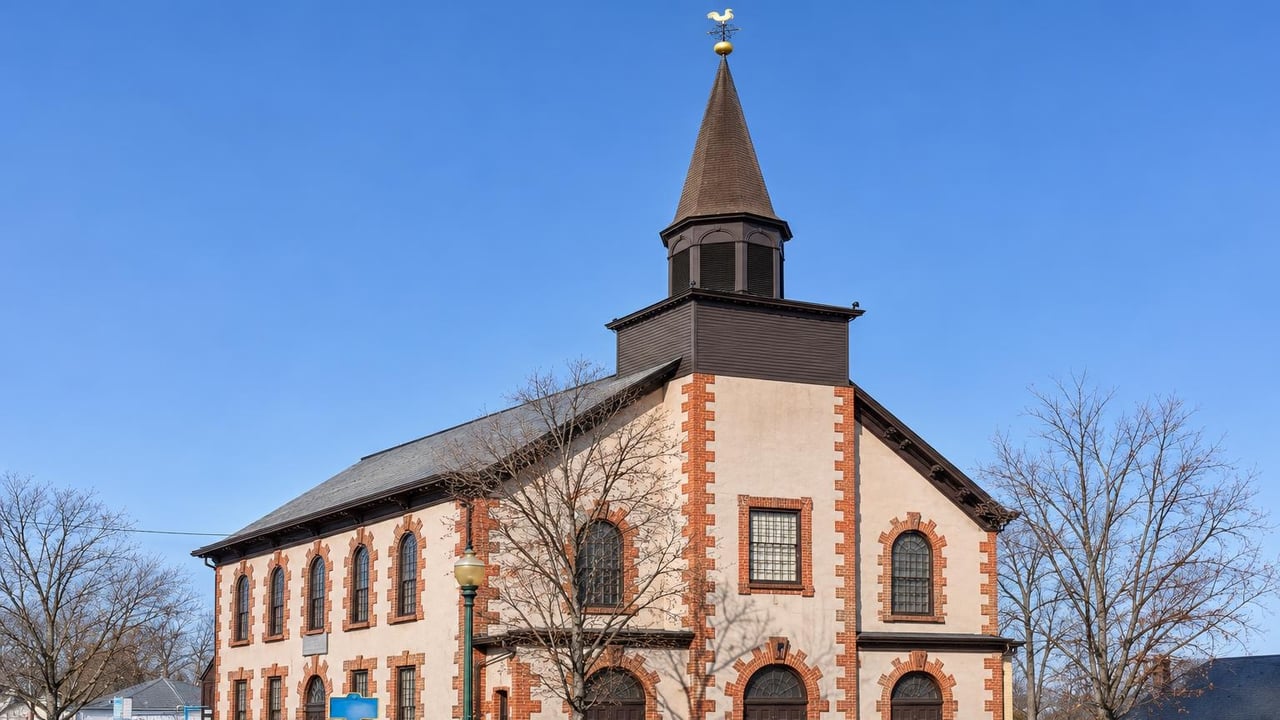
First Reformed Church at 1153 Main Street, a short walk west, was the army's military prison. Its congregation dates to 1716 and is the oldest continuing congregation in Dutchess County. The Provincial Congress met there, briefly making Fishkill the temporary capital of New York. John Jay, Philip Livingston, Lewis Morris and Robert Livingston all passed through, and Washington attended services. The gold-leaf rooster weather vane went up in 1795. The Historical Society invites visitors to walk the churchyard and read the old stones, the earliest dated 1737. The Town of Fishkill's history page lists Sunday worship and tours by appointment.
You can walk the same block in a few minutes and see more of the village's later history. The Mansion House at 1140 Main Street was built in 1789 by Isaac Van Wyck as an inn for the New York-to-Albany stagecoach line he helped found. It had a third-floor ballroom, and today it holds businesses and apartments. The federal-style house at 1089 Main Street, now McHoul Funeral Home, was built in 1811. It survived the 1873 fire that destroyed most of Main Street. According to local tradition, the house was protected because a bottle of spirits thrown over the roof when it was finished did not break. The brick building at 1064 Main Street, now Beast Barbecue, opened as a bank in 1853 and was later Fishkill's town hall until 1989. Its walls are 18 inches thick, and it still has the iron shutters bankers closed every night.
Out Route 52 to the Smallpox Hospital, and Old Glenham Road
The churchyard from the opening is at Rombout Rural Cemetery, 1571 Route 52. Jacobus Ter Bos gave the land for a meeting house and burial ground in 1747, and the church was finished in 1750. Locals called it the Middle church, probably because it stood between the churches of Fishkill and Hopewell. A limestone church replaced the war-damaged one in 1830 and burned on March 5, 1866. The open, grassy footprint on the cemetery's east side is what remains of both.
The Kip House at 155 Old Glenham Road is one more depot-era building. It is a stone house with stones marked 1753. During the Revolution it belonged to Evert Swart, who gathered supplies for the patriot cause. That connection is behind a long-told story that Baron von Steuben, Washington's drillmaster, stayed there. The Historical Society describes its doorway as one of the best examples of a primitive 18th-century divided door, with a bullseye in the upper half.
The Historical Society's site guide lists eight stops with addresses and map links. It also has an upload form for each site, so you can turn a holiday drive with visiting family into a scavenger hunt.
One Date for the December Calendar
On Saturday, December 19, at 2 p.m., Fishkill Rural Cemetery will hold its fifth annual Wreaths Across America observance, with volunteers laying wreaths on veterans' graves. The event page also has sign-ups for volunteers and wreath sponsors. If you go to the Homestead grounds the same day, plan around the dawn-to-dusk hours.
For a full afternoon, start at the Homestead and look across Snook Road at the work on the depot corner. Then drive into the village for the two churches and the Main Street buildings, and finish at Rombout Rural Cemetery on Route 52. If you like seeing historic sites in the off-season, our neighbors in Hyde Park keep their estate grounds open year-round too. For more on the towns around Fishkill, see our Southern Dutchess page.
If you live near Route 9 or Main Street and want to talk about how the Continental Commons work could change your stretch of Fishkill, Isabel R. Alves is always glad to talk it over. Let's Connect.